
READING GARDENS
by GINA DOVER-JAQUES
Why Analogue?
An artist's relationship with film photography
I didn't set out to become an analogue photographer. I wanted to elevate the aesthetic of my photographs, creating something exquisite and true to my sensibility as an artist. Having been a painter, I longed to bring that painterly quality into my photography.
I wanted images of beauty and permanence, photographs worthy of becoming heirlooms.
Analogue photography entered my life rather by chance.
I had invested in a one-to-one session with a photographer whose work I found utterly enchanting. Her photographs were poetic, with beautiful depth and an extraordinary eye for seeing beyond the obvious. I hadn't realised she worked with film.
Having observed how I photographed, she suggested I try her medium-format analogue camera.
Something rather wonderful happened. I fell in love. Not with the photographs, which I had yet to see, but with the experience of making them: the tactile pleasure of holding the camera, the attention I gave to the viewfinder, the sense of crafting an image rather than simply taking a photograph.
It felt natural almost immediately. But the greater revelation was still to come.
When the scans from my first rolls of film arrived, I was enthralled. There was a poetic quality, a depth and beauty I had been searching for without knowing quite how to achieve. The camera's expansive viewfinder had allowed me to see and express more. It felt as though my artistic sensibility had finally found its photographic expression.
Learning to see with film
After seeing those first photographs, I discovered I could look through the viewfinder and visualise how film might interpret what I was seeing. It developed instinctively, and that ability has stayed with me.
There is something immensely satisfying about seeing a photograph before it exists, trusting the film, the light and my choices in that moment.
And then there is the anticipation of seeing the developed photographs. During my years as a fine-art wedding photographer, receiving the email from my film laboratory announcing that my scans were ready felt rather like Christmas. I would become almost giddy with excitement, a feeling that stayed with me through downloading and finally opening the photographs. I could relive those moments, discovering how film had interpreted what I had experienced.
Seven years on, that excitement has never diminished. From photographing weddings to my work in gardens today, receiving my developed film scans remains one of the most thrilling parts of the process.
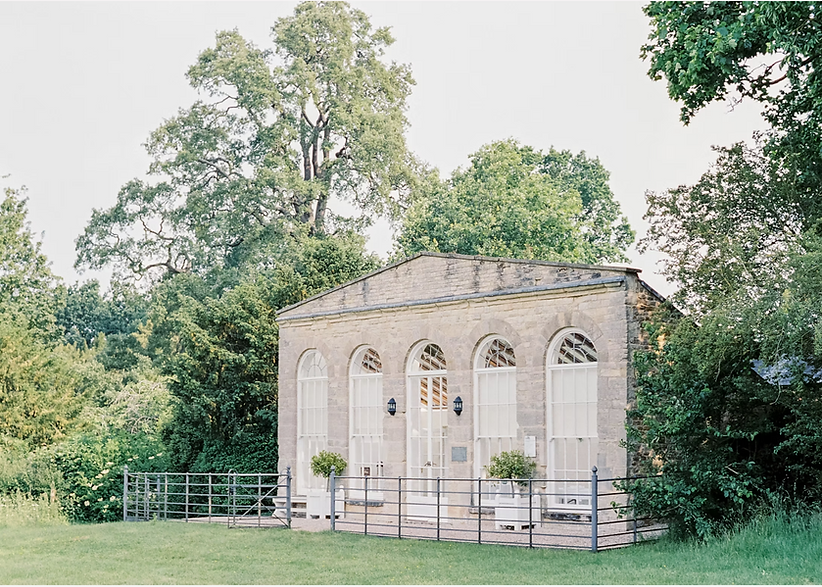
Mamiya 645 AF · 80mm f/1.9 · Kodak Portra 400
The beauty of film
For me, analogue photography has a beauty that is difficult to replicate, particularly in its rendering of colour. Nowhere is this more apparent to me than in a garden.
Gardens contain an extraordinary variety of greens, responding differently to light, shade and the seasons. I love the way film interprets their subtle variations, the depth of foliage and the gentle transitions between light and shade. They seem to reflect not simply what I saw, but how I experienced being there.
Skin tones matter equally to me. I favour Kodak Portra 400 and 800, films renowned for their beautiful rendering of skin tones across a wide range of complexions, from the palest to the deepest, with a warmth and subtlety I particularly value.
I work with an exceptional film laboratory whose understanding of my colour preferences is an important part of the finished result. When my photographs are returned as digital scans, I do not alter them. What you see is the interpretation achieved through my chosen film and the laboratory's carefully established process. With no need to spend time editing, I have more time to be behind the camera.


As the light began to fade, I returned to my 35mm Canon and its 50mm f/1.2 lens — the fastest lens I owned, and one I held in particularly high regard. It allowed me to continue working with the remaining natural light, responding instinctively to the conditions.
Canon 35mm · 50mm f/1.2 · Kodak Portra 400
The pleasure of craftsmanship
I work with analogue cameras, including my Canon 35mm, much-loved Mamiya 645 AF medium-format camera and a manual Leica.
If I could keep only one, it would undoubtedly be the Mamiya. It is a gloriously tactile camera.
The pleasure begins long before I make a photograph. Simply knowing I am going to spend time with my Mamiya fills me with anticipation, an almost giddy excitement at what we might create together.
The Mamiya and its 80mm f/1.9 prime lens are a marriage made in heaven. The exquisite sharpness at the point of focus, the beautiful grain of Kodak Portra film and the way everything beyond the subject falls gently into softness create a depth and intimacy I find utterly enchanting.
But my affection goes beyond the photographs. There is something wonderfully satisfying about the physical process: the camera in my hands, the sound of the shutter, changing a roll of film and, with my manually wound cameras, hearing the film advance one frame at a time. I love that physical involvement. It is all part of the romance.
I don't experience the limited exposures as a restriction. When a roll is finished, I simply change it. And I love doing so.
There is craftsmanship in the equipment itself, certainly. But what matters most is the craftsmanship it makes possible.
Connection, on both sides of the lens
Perhaps one of the most important things analogue photography has given me is the freedom to remain entirely present.
Years of working with my cameras have given me a quiet confidence in my craft. I trust my eye and instincts, recognising and capturing moments as they unfold, without needing immediate reassurance of the resulting photograph. That familiarity allows my attention to remain with the person, rather than the camera.
People I've photographed have often told me how quickly they relax in my company. The experience becomes less about being photographed and more like spending time together, enjoying a conversation and the space around us. I like to think of myself as simply a friend with a camera.
For me, the slowing down happens within. It is a greater attentiveness to what I am seeing, hearing and experiencing, rather than a slowing of what unfolds before me.
This has become particularly important in Reading Gardens, my developing photographic project exploring how people with specialist knowledge experience gardens.
I don't ask people to repeat an action, pause what they are doing or turn towards a preferred viewpoint. Their experience takes precedence over my photograph. I observe, respond and accept what presents itself.
Analogue photography feels entirely at home within that approach.
Something worth preserving
My aspiration to create photographs of exceptional, heirloom quality has never left me.
But along the way, I discovered something I hadn't anticipated: the experience of making a photograph could be every bit as meaningful as the photograph itself.
The craftsmanship. The attention. The pleasure. The connection.
All of these have become inseparable from the way I work. And perhaps that is why I continue to choose analogue photography. Not because it is the only way to make beautiful photographs, but because it is the way that feels most natural, most rewarding and most entirely my own.
From the Negative
Before becoming finished photographs, these images existed as small frames of film, holding the light and the moments in which they were made.

The Arbour · Canon 35mm · Kodak Portra 400

The Woodland · Canon 35mm · Kodak Portra 400