GINA DOVER-JAQUES

Rousham's Quiet Theatre
A place of subtle theatre, with the visitor being its protagonist, just as William Kent intended.
May 2023
Rousham is historically significant as one of the earliest English landscape gardens and the finest surviving example of William Kent’s work. It stands as a cornerstone of the picturesque movement, an almost completely unaltered 18th‑century landscape that embodies narrative, theatrical garden design and reflects continuous family stewardship across centuries.
It is not simply a garden; it is a preserved moment in landscape history, offering a direct, authentic window into the artistic revolution that reshaped English garden design.


Echoeing Kent's Philosophy
Kent’s philosophy, his serenity, staging, and mastery of sequence was immediately evident. The garden unfolds as a series of scenes: pathways that guide the eye, views framed by dark‑to‑light transitions, water features acting as calm focal points, and architectural elements emerging gently from shadow. Experiencing this was a joy to all the senses, and it is precisely this genius of Kent that I hope my images convey.
Wandering alone rewarded me with a profound sense of privilege, privacy, and intimacy, qualities I wanted my photography to reflect. Rousham’s pathways, rills, and hedges naturally lend themselves to visual flow, while its subtle palette of greens, stone, shadow, and soft English light harmonised perfectly with the quiet sensitivity of my work and the gentle character of film.


My first visit, but not my last
I was intrigued by Rousham after hearing Monty Don describe William Kent as the genius of eighteenth‑century garden design, and Rousham as his masterpiece.
Rousham in Oxfordshire, pronounced Rowsh‑ham, was among the first landscape gardens created in England and is regarded by many as the most influential. William Kent, a true polymath, was commissioned by the Cottrell-Dormer family in the late 1730s to design its gardens and grounds. The family still own and live at Rousham today. Its quiet charm continues to draw landscape architects, garden designers, and garden lovers from across the world.
The approach to Rousham leads through peaceful, unassuming parkland grazed by the ancient Old English Longhorn cattle, with the house nestled gracefully into the landscape. With no café or shop to disrupt the mood, an intimate, almost private atmosphere prevails. It feels unlike any other garden I have visited. Not encountering another soul, I felt as though the grounds belonged to me for the day.
April showers and stubbornly unsettled weather kept me away for what felt like an eternity. After three long weeks, I finally ignored the forecast and arrived at midday, determined to stay until sunset. Persistent rain and the distant rumble of thunder limited my time behind the camera, yet none of it dimmed the pleasure of immersing myself in the theatre that is Rousham.

Parterre garden & Dovecote dating back to 1685
- a grade II listed building in the walled garden -
There are many ways to enjoy Rousham, the intended starting point is from the Bowling Green in front of the house looking out to Steeple Aston. Part of Kent's genius was to blur the lines between garden and countryside; which he achieved through a folly that stands on the outskirts of Steeple Aston, to suggest Rousham's boundary. I started in the Parterre Garden after spying the Dovecote from the courtyard car park, and finished at the base of the Vale of Venus next to the River Cherwell, a perfect finale.


St Leonard & St James Church
I love this view of the Church of St Leonard & St James, that dates back to the 12 century, with the neatly clipped Yew topiary hedge and archway. Since my visit, I discovered that the church can be approached through an arch between a set of cottages and along a short path lined with neatly clipped Yew topiary. Something to be mindful of during my next visit.

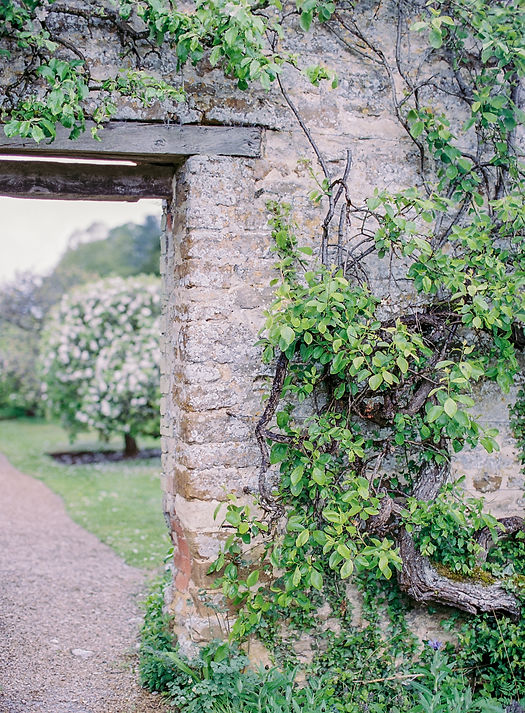
The Walled Garden
After walking through the archway of the immaculately clipped hedge seen earlier in the image of the church, and passing through the walled vegetable garden, I found myself in the walled garden with a pathway named 'the long walk' adorned by trained apple and pear trees that were in blossom.


Roman Dying Gladiator
Statue of a Roman dying Gladiator tomb monument by Peter Scheemakers. If you were to peer down from the balustrade behind the monument, you would see beneath the seven arched Praeneste.

Seven Arched Praeneste
Kent modelled the seven arched colonnade on the ruins at Palestrina outside of Rome, Italy.
The Praeneste can be reached via a pathway to the right at the end of the Bowling Green, then left after walking partway toward the River Cherwell.
After creating a few images, I sat a while inside the Praeneste to take in the serene view of the Cherwell before moving onto the Vale of Venus.

The Vale of Venus
Statue of a Roman dying Gladiator tomb monument by Peter Scheemakers. If you were to peer down from the balustrade behind the monument, you would see beneath the seven arched Praeneste.


As I reached the River Cherwell, I looked back up through the Vale and whispered a fond adieu to Venus. The gentle sway of the trees, and the evening chorus from the birds, made this a particularly sweet parting.


